Is Rugby Older Than Football? The Real History Behind Both Sports

Rugby vs Soccer Historical Timeline Tool
Compare key historical milestones of rugby and soccer development. This tool visualizes the chronological sequence of events that established rugby as the older sport.
Rugby Timeline
William Webb Ellis at Rugby School picks up the ball and runs with it, breaking the rules of the time.
First written rules of rugby football published at Rugby School.
First official international rugby match played between Scotland and England.
Rugby Football Union (RFU) founded in England.
Soccer (Association Football) Timeline
Students at Cambridge University draft rules banning handling the ball.
Football Association (FA) establishes formal rules banning handling the ball.
First official international soccer match played between England and Scotland.
Football Association (FA) established as governing body.
Rugby's First Rulebook
Soccer's First Rulebook
Time Difference
When people talk about the oldest team sports, football usually comes to mind. But if you dig into the real story, rugby might have beaten it to the punch - by decades. The question isn’t just about which game came first. It’s about how two sports we think of as totally separate actually grew from the same root.
Where Rugby Really Began
Rugby’s origin story isn’t some myth. It’s tied to a single moment in 1823 at Rugby School in Warwickshire, England. According to school records and later accounts, a student named William Webb Ellis picked up the ball during a football match and ran with it. That act broke the rules of the time - which only allowed kicking - and started something new.
It wasn’t an instant revolution. For years, different schools played their own versions of football. Some allowed handling, others didn’t. But by the 1840s, Rugby School had formalized its rules. They wrote them down, stuck to them, and taught them to new students. By 1845, the first written rules of rugby football were published. That’s the first time anyone had codified a game where you could carry the ball.
That’s not just a footnote. It’s the birth certificate of a sport. Rugby didn’t evolve slowly over centuries. It was invented, named, and documented - all within a single school, in less than 25 years.
What Was Football Like Back Then?
When people say "football," they usually mean association football - soccer. But in the early 1800s, "football" wasn’t one game. It was dozens. Every town, every school, had its own version. Some games had 100+ players on each side. Some allowed punching. Others banned touching the ball entirely. There was no standard. No national rules. No governing body.
The first attempt to unify these chaotic versions came in 1848 at Cambridge University. Students from different schools met to draft a common set of rules. They banned handling the ball. They focused on kicking. That version became the foundation for what we now call soccer.
But here’s the key point: the Cambridge Rules of 1848 were still not official. They were just a draft. It wasn’t until 1863 that the Football Association (FA) was formed in London. That’s when association football got its first formal, binding rulebook - and banned handling the ball completely. That’s when soccer became its own sport, separate from rugby.
So while rugby had a written rulebook in 1845, association football didn’t get one until 1863. That’s 18 years later.
The Split That Created Two Sports
By the 1870s, rugby had spread beyond schools. Clubs formed. Matches became popular. But not everyone agreed on how the game should be played. Some clubs wanted to keep handling the ball, running with it, and tackling hard. Others thought football should stay purely kicking-based.
In 1871, the Rugby Football Union (RFU) was founded in England. It was the first official governing body for rugby. That same year, the Football Association had already been around for eight years, managing soccer.
The real split came in 1895. A group of northern English rugby clubs - mostly working-class teams - wanted to pay their players. The RFU said no. They believed rugby should stay amateur. So those clubs broke away and formed the Northern Rugby Football Union. That new organization slowly changed the rules: fewer players, shorter matches, the introduction of the play-the-ball. That version became rugby league.
Meanwhile, the original rugby - now called rugby union - stayed true to its 1845 roots. Both versions still carry the DNA of that 1823 moment at Rugby School.

Why People Get This Wrong
Modern football - soccer - is the most popular sport on the planet. It’s played everywhere. So it feels ancient. But its global dominance came later. The FA didn’t even start international play until 1872, when England played Scotland.
Rugby, by contrast, was already being played internationally by the 1870s. The first international match was between Scotland and England in 1871 - two years before the first official soccer international. Rugby was also played in Australia, New Zealand, and South Africa before the 1880s.
What most people don’t realize is that soccer didn’t "win" the race to be called football. It just became the most widespread version. The word "football" stuck to the kicking game because it was the most common form in England. But the sport that came first - the one that allowed handling, running, and tackling - was rugby.
What About American Football?
American football is a cousin, not a parent. It evolved from rugby in the late 1800s. Walter Camp, a Yale student, started changing the rules in the 1880s: he introduced the line of scrimmage, the snap, and downs. He took rugby’s chaotic scrum and turned it into a structured game. By 1906, American football was so different that it had its own association.
So while American football looks nothing like rugby today, it still owes its existence to that 1823 moment at Rugby School. The same goes for Canadian football and rugby league.
The Verdict: Rugby Came First
By any historical measure, rugby is older than association football (soccer). The first written rules were published in 1845. The first official governing body formed in 1871. The first international match happened in 1871.
Association football didn’t get its first rulebook until 1863. The first international match wasn’t until 1872. That’s a clear 18-year gap.
And if you’re thinking about American football, rugby is even older - by more than 40 years.
So yes - rugby is older. Not just a little older. Significantly older. And it didn’t just influence football. It *was* football - until people decided to split it.
Why This Matters Today
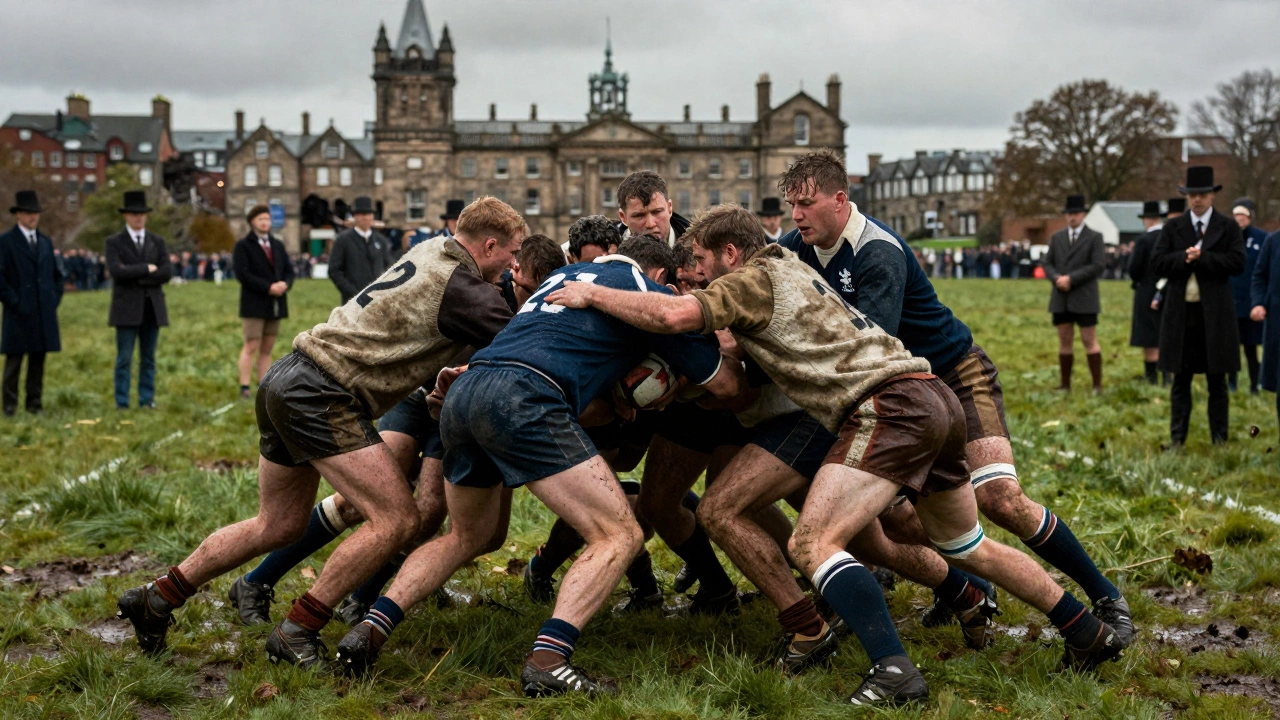
Knowing this history changes how you watch the game. When you see a rugby scrum, you’re seeing a ritual that’s been unchanged since the 1840s. When you see a soccer player kick a penalty, you’re seeing a rule that was written in 1863 - and that rule only exists because rugby came first.
It also explains why rugby is still so popular in places like New Zealand, Fiji, and Wales. Those countries didn’t just adopt a sport. They inherited a tradition that predates modern soccer by decades. Rugby isn’t just a game there - it’s living history.
And if you ever hear someone say "football has always been about kicking," you’ll know they’re missing the bigger picture. The original football wasn’t about kicking at all. It was about grabbing the ball and running - just like William Webb Ellis did in 1823.
Is rugby the original football?
Yes, rugby is the original form of football that allowed handling the ball. Before 1863, "football" meant many different games, but the version played at Rugby School - where players could pick up the ball and run - was one of the most organized. The Football Association was created in 1863 to standardize rules that banned handling, which led to soccer. Rugby kept the original rules and became its own sport.
When were the first official rugby rules written?
The first written rules for rugby football were published in 1845 by students at Rugby School in England. These rules allowed players to carry the ball, tackle opponents, and score by grounding the ball over the goal line. This document is considered the birth of rugby as a distinct sport.
Did soccer evolve from rugby?
No, soccer didn’t evolve from rugby. Both sports came from the same family of traditional English football games. In the early 1800s, schools played different versions. Rugby School developed a handling version. Cambridge and later the Football Association developed a kicking-only version. They split apart, they didn’t evolve from each other.
What’s the oldest international rugby match?
The first official international rugby match was played on March 27, 1871, between Scotland and England at Raeburn Place in Edinburgh. Scotland won 1-0. This was two years before the first official international soccer match between the same two teams in 1872.
Why do some people think football is older than rugby?
Because soccer became the global standard, many assume it’s the oldest. But popularity doesn’t equal age. Soccer’s rules were formalized later - in 1863 - while rugby had written rules since 1845. Also, "football" was used for many games before the split, so people forget rugby was once called "rugby football."