What Do Americans Call Rugby? Understanding the Name Confusion

Rugby vs. American Football Translator
Confused by the similarities? Use this tool to translate Rugby concepts for your American friends.
Select a term above to see the comparison.
Here is a fact that trips up almost every European visitor to the United States: if you ask an average American about "rugby," they might look at you blankly. But if you ask them about "football," they will launch into a passionate debate about the NFL. The confusion isn't just about rules; it’s about names, history, and a deep-seated cultural divide. So, what do Americans actually call rugby? The short answer is... well, it depends on who you ask and which version of the game they are watching.
If you walk into a sports bar in Chicago or New York and mention rugby, you’ll likely get two reactions. One group knows exactly what you mean-they follow USA Rugby or watch international matches. The other group assumes you’re talking about a variant of American football. This article breaks down why this confusion exists, how Americans refer to the sport, and the key differences between the games that share similar roots but live in completely different worlds.
The Short Answer: They Just Call It Rugby
Let’s clear the air first. In the vast majority of contexts, especially within the sporting community, Americans call it Rugby. There is no secret slang term like "soccer" for association football. If you are playing club rugby in San Francisco or watching the Six Nations on TV, everyone calls it rugby.
However, the problem arises when you talk to someone who doesn’t follow the sport. For many Americans, the word "rugby" sounds foreign or niche. Because American Football evolved from early forms of rugby in the late 19th century, some older generations or casual fans might mistakenly conflate the two. You might hear phrases like "that looks like rugby without pads" or "it’s just soccer with hands." These aren’t official names, but they reflect the general lack of awareness.
So, if you are planning to visit the US and want to catch a match, don’t worry about finding a hidden local name. Search for "Rugby Union" or "Rugby League" depending on your preference, and you will find the right events. The challenge isn’t the name-it’s finding the audience.
Why the Confusion Exists: A Shared History
To understand why Americans struggle with the name, you have to look at the family tree. Both American Football and Rugby Union started as variations of rugby football played in British public schools. In the 1870s and 1880s, colleges like Harvard, Yale, and Princeton were experimenting with different rules.
At one point, there was a serious competition between the "Boston Game" (which allowed kicking) and the "Princeton Rules" (which favored running). Eventually, Walter Camp, often called the "Father of American Football," introduced changes like the line of scrimmage and downs. These changes created a distinct sport that diverged sharply from its rugby cousin. But because the DNA is shared, the visual similarities remain strong enough to cause confusion.
This historical split means that while the UK sees Rugby and Soccer as separate global giants, the US sees American Football as the dominant gridiron sport, with Rugby struggling for visibility. When an American hears "rugby," they often picture players tackling each other without helmets-a concept that seems terrifying and illogical to those raised on the safety-first culture of the NFL.
Rugby Union vs. Rugby League: The American Blind Spot
Even among Americans who know what rugby is, most cannot distinguish between Rugby Union and Rugby League. This distinction is crucial for anyone trying to explain the sport to a friend.
- Rugby Union: This is the more common form globally, featuring 15 players per side. It includes scrums, lineouts, and rucks. The All Blacks and Springboks play this version. In the US, this is what most people mean when they say "rugby."
- Rugby League: Played with 13 players per side, this version has fewer stoppages and uses a six-tackle rule instead of rucks. It is huge in Australia, England, and New Zealand but barely known in the US outside of expat communities.
When Americans try to describe what they saw on TV, they rarely use these technical terms. Instead, they might say, "It looked like football, but the ball kept moving," referring to Union, or "They didn’t stop after every tackle," referring to League. The lack of terminology highlights the gap in media coverage. Unlike in the UK, where Sky Sports or BBC provides detailed commentary distinguishing these codes, US broadcasts often gloss over the details.
Terminology Translation: Speaking the Language
If you want to bridge the gap between your rugby knowledge and your American friends’ understanding, you need to translate the concepts. Here is how common rugby terms map to their American equivalents-or how they fail to map at all.
| Rugby Term | Literal Meaning | American Football Equivalent (Approximate) | Key Difference |
|---|---|---|---|
| Try | Grounding the ball in the in-goal area | Touchdown | No forward pass required; can be scored by any player. |
| Conversion | Kick after scoring a try | Extra Point / PAT | Can be kicked from anywhere along the line of the try. |
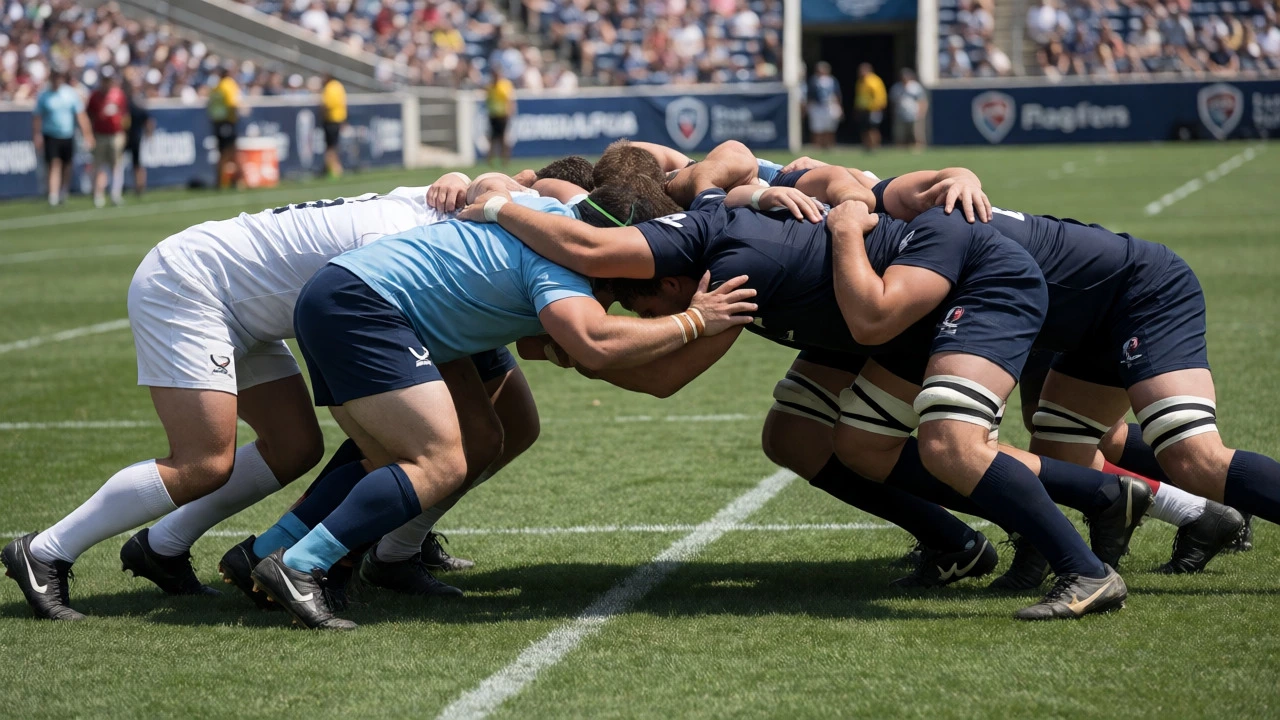
| Scrum | Formal restart with eight forwards pushing | None | No direct equivalent; closest to a huddle or line of scrimmage setup. |
| Lineout | Throw-in from sideline | Inbound Pass | Players jump to catch the ball; complex set piece. |
| Ruck | Players bind over the ball on the ground | None | Continues play; ball must come out before next phase. |
| Knock-on | Dropping the ball forward | Fumble (forward) | Results in a scrum, not just a turnover of possession. |
Notice how many rugby concepts have no direct American equivalent. Terms like "scrum" and "ruck" are unique to rugby. This is why explaining the game can feel like teaching a new language. Americans are used to a stop-start game with specialized units (offense, defense, special teams). Rugby requires continuous endurance and versatility, where every player must be able to run, pass, kick, and tackle.
Cultural Perception: Why It Doesn’t Catch On
You might wonder, if the games are so similar, why doesn’t rugby take off in the US? The answer lies in infrastructure and culture. American Football is deeply embedded in the school system. Kids start playing flag football at age five, move to tackle football in high school, and dream of college scholarships. Rugby has no such pipeline in most states.
Furthermore, the equipment barrier is real. To an American parent, watching teenagers crash into each other without helmets looks dangerous. The idea of "no padding" is hard to sell. However, proponents argue that rugby’s technique-focused approach reduces concussions compared to helmet-dependent football. Still, perception wins over data in marketing.
There is also the issue of pacing. American audiences love statistics, replays, and commercial breaks. Rugby’s continuous flow feels chaotic to some viewers. While Major League Rugby (MLR) has tried to bring professional rugby to US cities since 2018, it struggles to compete with the entrenched popularity of the NFL, NBA, and MLB.

Where to Find Rugby in America Today
Despite the challenges, rugby is growing. If you are looking to engage with the sport in the US, here are the hotspots:
- College Clubs: Many universities have club teams that compete in national tournaments. These are often run by students and offer a grassroots entry point.
- Major League Rugby (MLR): Teams like the Seattle Seawolves, LA Giltinis, and Austin Gilgronis play professionally. Matches are broadcast on CBS Sports Network and streaming platforms.
- Expat Communities: Cities with large Australian, British, or South African populations-such as New York, Los Angeles, and Miami-have vibrant social clubs.
- High School Programs: States like California, Texas, and Massachusetts are seeing increased participation in high school rugby leagues.
Attending a local club match is the best way to experience the culture. Unlike the corporate atmosphere of NFL stadiums, rugby clubs are often community-driven. Post-match beers are mandatory, and the camaraderie is genuine. This "third half" tradition is something Americans are beginning to appreciate as an alternative to the hyper-commercialized sports entertainment industry.
Final Thoughts: Bridging the Gap
So, what do Americans call rugby? They call it rugby, but they often misunderstand it. The name isn’t the problem; the context is. By taking the time to explain the simple mechanics-like how a try is scored or why a scrum happens-you can turn a confused glance into curiosity. And once they see the skill involved in a lineout lift or a sidestep tackle, the respect usually follows.
If you are an expat living in the US, don’t hesitate to invite your colleagues to a match. Bring a beer, explain the basics, and let the action speak for itself. Who knows? You might just convert another fan to the beautiful chaos of rugby.
Do Americans confuse rugby with soccer?
Not typically. Most Americans clearly distinguish between soccer (association football) and rugby. The confusion is almost exclusively between rugby and American football due to the shared physical contact and oval-shaped ball. Soccer is widely recognized as a non-contact foot-based game, whereas rugby is seen as a hand-based contact game.
Is rugby popular in the United States?
Rugby is a niche sport in the US compared to major leagues like the NFL or NBA. However, it has a dedicated following, particularly in coastal cities, college towns, and areas with significant immigrant populations from rugby nations. Major League Rugby has helped increase visibility, but it remains far behind mainstream sports in viewership.
Why don't rugby players wear helmets?
Rugby laws traditionally prohibit hard protective gear like helmets to encourage proper tackling technique. Players believe that relying on helmets leads to poor form, such as leading with the head, which increases injury risk. Scrum caps are allowed but are soft and primarily prevent cauliflower ear rather than concussions.
What is the difference between Rugby Union and Rugby League?
Rugby Union features 15 players per team, uses rucks and mauls, and allows unlimited tackles until the ball moves. Rugby League features 13 players, uses a six-tackle count, and does not allow rucks or mauls. Union is more strategic and set-piece heavy, while League is faster-paced and more continuous.
Can I play rugby in the US without prior experience?
Yes, many clubs welcome beginners. Look for "social rugby" or "touch rugby" leagues, which focus on fitness and fun rather than full-contact intensity. Local USA Rugby affiliates can help you find introductory programs near you. College clubs are also often open to novices.