Why is Rugby Called Rugby? The True Story Behind the Name
Rugby History Timeline Explorer
Discover how a schoolyard game became a global phenomenon
Click on any event below to explore the full story
Have you ever wondered why a sport involving tackling, kicking, and carrying an oval ball is called rugby? It’s not a verb. It’s not a description of the action on the field. It’s simply the name of a town in Warwickshire, England. But getting from a small English market town to a global sporting phenomenon with over 120 million players worldwide involves a mix of fact, legend, and one very specific moment at a boarding school.
The short answer is that the game is named after Rugby School, where the distinct style of play was codified in the 19th century. However, the long answer is much more interesting. It involves a boy named William Webb Ellis, a rulebook written by teachers, and a split in the football world that created two entirely different sports.
The Legend of William Webb Ellis
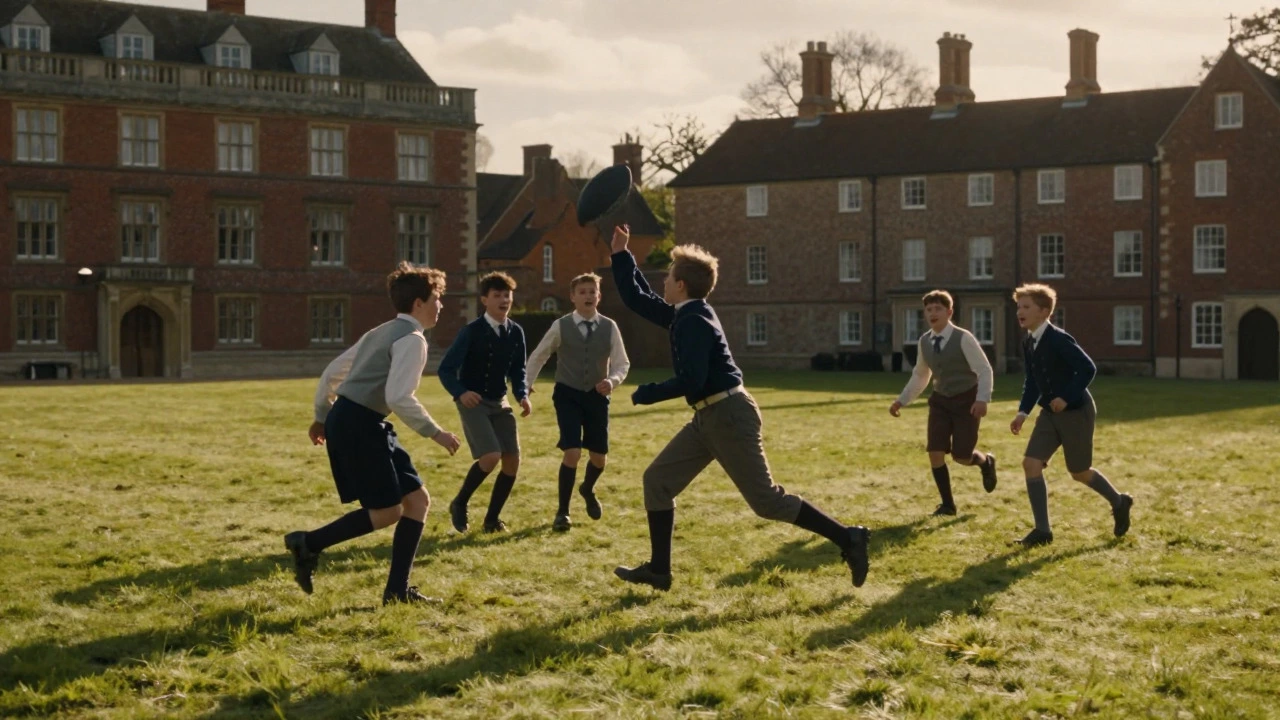
If you ask most rugby fans how the sport got its name, they will tell you the story of William Webb Ellis. According to this popular legend, during a regular game of football at Rugby School in 1823, Webb Ellis picked up the ball and ran with it toward the opponent's goal. This act of defiance against the rules of the time-where handling the ball was strictly forbidden-is said to have inspired the unique nature of the game.
This story is so central to the culture of the sport that the Webb Ellis Cup, awarded to the winner of the Rugby World Cup, is named after him. There is even a plaque at Rugby School commemorating the event. However, historians generally agree that this story is likely apocryphal. There is no contemporary record of such an incident in 1823. In fact, Webb Ellis himself never claimed to have invented the game.
So, if he didn’t pick up the ball, why does his name live on? The legend was popularized decades later by John Thwaites, a former pupil of the school, who wrote about it in 1876. It served as a neat, heroic origin story for a sport that was struggling to define itself. While the specific moment might be fiction, the spirit of innovation attributed to Webb Ellis reflects the reality of what was happening at the school.
Rugby School and the Codification of Rules
The real reason the sport bears the name "Rugby" lies in the administrative decisions made by the masters at Rugby School. In the early 19th century, "football" was not a single, unified game. It was a chaotic collection of local variants played across England. Some allowed handling, some didn't. Some used round balls, others used irregularly shaped ones. Each school had its own rules.
At Rugby School, the tradition favored handling the ball. Students would often pick up the ball to run around opponents or pass it backward to teammates. This style became known as "Rugby Football" to distinguish it from the "London Football" or "Cambridge Rules" styles that prohibited handling. The key difference wasn't just picking up the ball; it was the strategic use of passing and running that defined the game.
In 1845, a group of students and masters at Rugby School decided to write down these unwritten customs. They published the first official set of rules for the game. This document, known as the "Laws of the Game," formalized the allowance of handling the ball and established the basic structure of matches. By writing these rules down, they created a reproducible system that could be taught and played elsewhere. This codification is the true birth of rugby as a distinct sport.
The Great Schism: Rugby vs. Association Football
The name "Rugby" stuck because of a major conflict in the mid-19th century regarding the future of football in Britain. As universities like Oxford and Cambridge began standardizing their own rules, a debate erupted over whether handling the ball should be allowed. The Cambridge Rules of 1848 leaned toward prohibiting handling, favoring kicking and dribbling.
This divide came to a head in 1863 when representatives from various clubs met in London to form the Football Association (FA). The goal was to create a single, universal code of football. However, during the meetings, a proposal to ban handling the ball completely caused a rift. Clubs from the south of England, particularly those associated with public schools like Rugby, wanted to keep the handling aspect. Northern clubs and those influenced by the Cambridge Rules wanted a kicking-only game.
When the FA voted to exclude handling, seven clubs withdrew from the meeting. These clubs formed their own association, keeping the rules that allowed carrying and passing the ball. They retained the name "Rugby Football" to honor the school where the style originated. The other side became "Association Football," which eventually shortened to "Soccer." This schism permanently separated the two codes, ensuring that the handling-based game would forever carry the name of the town in Warwickshire.

From Public Schools to Global Sport
Once the rules were codified and the name established, rugby spread rapidly through the British Empire. Teachers, soldiers, and merchants took the game with them to Australia, New Zealand, South Africa, and France. In each location, the game adapted to local conditions but retained its core identity and name.
In New Zealand, the Maori people embraced the sport, integrating their cultural traditions into the haka performed before matches. In Australia, the game evolved into two distinct forms: Rugby Union and Rugby League. The split between Union and League occurred in 1895 in northern England, driven by disputes over compensation for working-class players who lost wages by playing on Saturdays. Despite this internal division, both codes kept the name "Rugby" to maintain their historical lineage.
The globalization of the sport meant that "Rugby" became a brand recognized worldwide. Today, the term refers primarily to Rugby Union, governed by World Rugby (formerly the International Rugby Board). The name serves as a constant reminder of the sport's humble beginnings in a classroom in England, rather than its current status as a high-intensity international spectacle.
Why Not Just Call It 'Handling Football'?
You might wonder why the sport didn't adopt a descriptive name like "Handling Football" or "Running Football." Naming conventions in sports are rarely logical; they are deeply tied to place and prestige. Cricket is named after the county of Kent (or possibly a Dutch word), Tennis comes from the French "tenez" (hold), and Basketball was named for the peach baskets used in its invention.
For rugby, the name carried weight because Rugby School was one of the most prestigious institutions in England. Associating the new sport with such a respected name gave it legitimacy. It signaled that this was a gentleman's game, rooted in discipline and tradition. As the sport professionalized and moved away from its amateur roots, the name remained a link to that heritage. Changing the name would have severed the connection to the rules' originators and confused the existing fan base.

The Evolution of the Name in Modern Context
In modern usage, the word "Rugby" has taken on a life of its own. When people say "I play rugby," they usually mean Rugby Union. If they play the faster, more structured variant with a play-the-ball restart, they specify "League." The brevity of the word makes it easy to use in headlines, merchandise, and casual conversation. It has become synonymous with values like resilience, camaraderie, and physical toughness.
The name also helps differentiate the sport in countries where "football" means something else. In the United States, Canada, and Australia, "football" refers to gridiron codes or Australian Rules Football. Using "Rugby" avoids ambiguity. It clearly identifies the sport as part of the global rugby family, distinct from soccer or American football.
| Code | Origin Location | Key Differentiator | Governing Body |
|---|---|---|---|
| Association Football | London, England | No handling (except goalkeeper) | FIFA |
| Rugby Union | Rugby, Warwickshire | Backward passing, scrums, rucks | World Rugby |
| Rugby League | Northern England | Play-the-ball, 13 players, limited tackles | International Rugby League |
Understanding the Cultural Significance
The name "Rugby" is more than just a label; it is a cultural identifier. In many countries, the sport is associated with community clubs, local rivalries, and national pride. The simplicity of the name allows it to transcend language barriers. Whether you are watching a match in Paris, Buenos Aires, or Auckland, the term remains the same.
Furthermore, the name connects the modern professional athlete to the student origins of the game. Even though today's players are highly trained professionals earning significant salaries, the core rules remain largely unchanged since the 1845 codification. The name serves as a reminder that the sport was born out of schoolyard games and educational ideals, emphasizing character development alongside physical competition.
Did William Webb Ellis really invent rugby?
Most historians believe the story of William Webb Ellis picking up the ball in 1823 is a myth. There is no contemporary evidence to support it. However, the legend persists because it provides a compelling narrative for the sport's origins. The actual invention was a gradual process of codifying rules at Rugby School in the 1840s.
Why is it called Rugby and not Soccer?
What is the difference between Rugby Union and Rugby League?
Rugby Union and Rugby League split in 1895 due to disputes over player payments. Rugby Union traditionally banned professional payments until 1995, while Rugby League allowed them earlier. Key differences include the number of players (15 vs 13), the method of restarting play (scrum/ruck vs play-the-ball), and the tackle limit (unlimited vs 6).
Where is Rugby School located?
Rugby School is located in the town of Rugby, in the county of Warwickshire, England. It is one of the oldest and most famous independent schools in the UK, founded in 1567.
When were the first rugby rules written?
The first official laws of rugby were written in 1845 by students and masters at Rugby School. This document formalized the practice of handling the ball and laid the foundation for the modern game.
Is rugby played all over the world?
Yes, rugby is played in over 120 countries. It is particularly popular in nations of the Commonwealth such as New Zealand, Australia, South Africa, England, Wales, Scotland, Ireland, and France. It is also growing in popularity in Asia, North America, and South America.