The Science Behind Rugby Players' Massive Legs
Rugby Power & Muscle Focus Tool
Analysis Results
Select options and calculate...
Fill in the details to see your rugby physiological profile.
The Physics of the Scrum and Collision
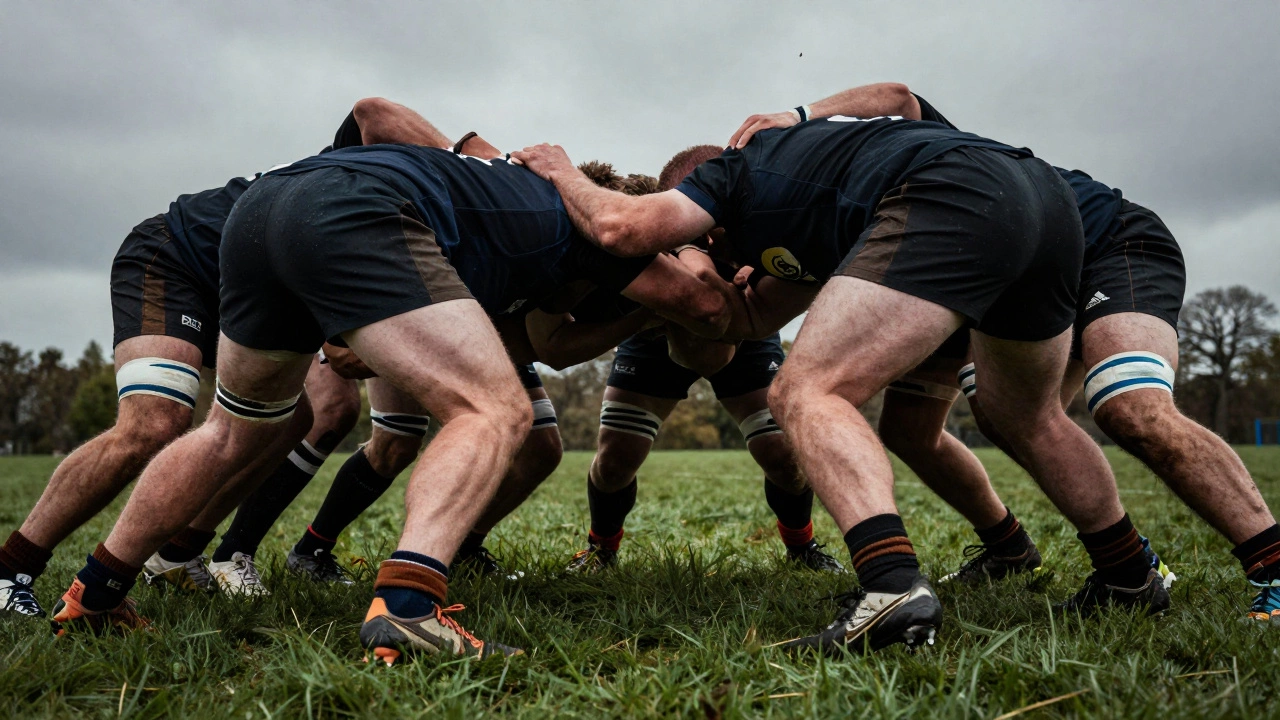
Imagine two walls of muscle colliding at full speed. When a prop engages in a scrum, they aren't just pushing; they are resisting thousands of Newtons of force. To maintain a stable base and move the opposition backward, a player needs a massive amount of surface area and muscle fiber in their legs. The Scrum is essentially a living tug-of-war where the ground is the only thing keeping you from falling over. If your legs are thin, you lack the leverage to drive forward. Big quads and glutes allow a player to keep their center of gravity low. When you have a deeper, more muscular base, you can transfer force from the ground through your legs and into the opposing pack more efficiently. It's basic physics: more muscle mass equals more potential force production.Explosive Power and Fast-Twitch Fibers
It isn't just about size; it's about how those muscles fire. Rugby players rely heavily on Fast-Twitch Muscle Fibers, which are the fibers responsible for quick, powerful bursts of movement. Whether it's a winger sprinting for the corner or a flanker launching themselves into a tackle, the ability to accelerate from zero to top speed in a few strides is critical. To build this, players focus on rugby leg muscles through explosive movements. This leads to hypertrophy-the enlargement of muscle cells. When a player performs a heavy squat or a power clean, they create micro-tears in the muscle. As the body repairs these tears with more protein, the muscle grows larger and stronger. Over years of professional training, this process results in the characteristic "thick" look of a rugby player's legs.The Role of the Posterior Chain
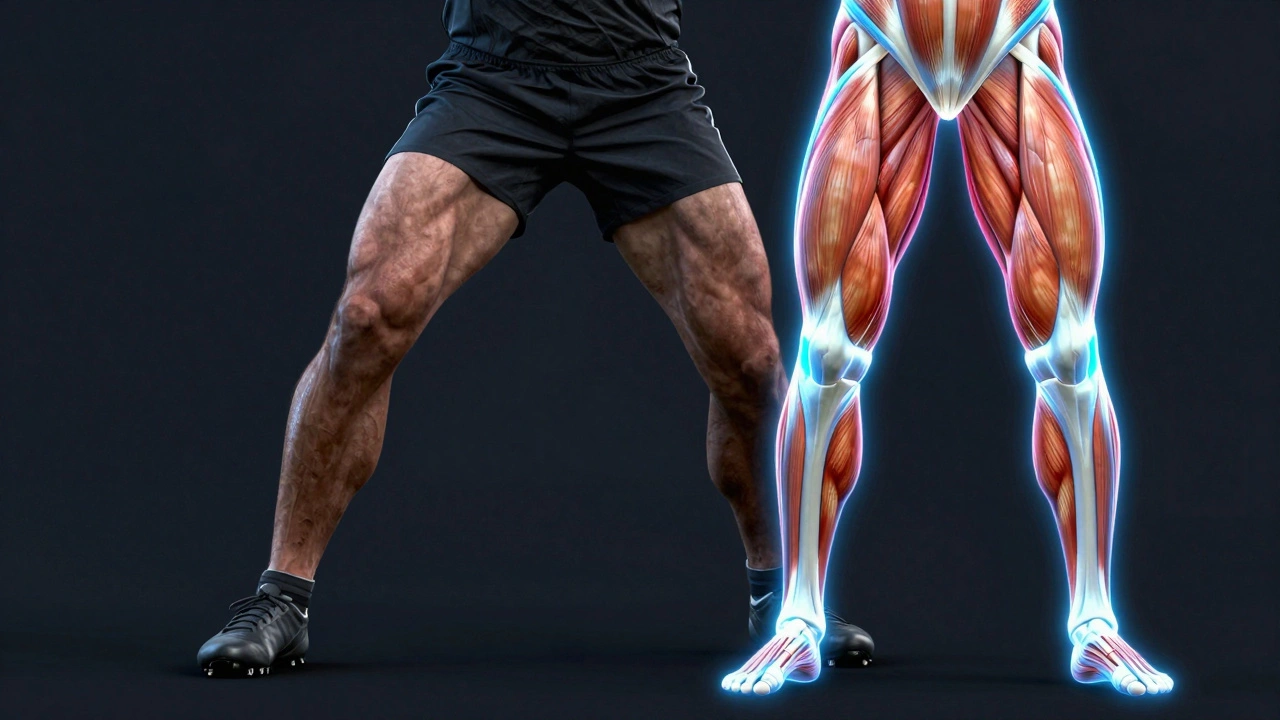
While the quads get the most attention, the real power comes from the back of the legs. The "posterior chain" refers to the muscles running from the lower back down to the calves. In rugby, this includes the Gluteus Maximus and the Hamstrings. These muscles act as the primary drivers for acceleration and stability. When a player hits a ruck, they are driving through their heels, pushing off the turf with everything they have. Strong hamstrings also protect the player from injuries, particularly ACL tears, by stabilizing the knee joint during sudden changes in direction. If a player only had big quads without the posterior chain support, they'd be prone to injury and lack the balance needed to stay upright during a tackle.| Muscle Group | Primary Function | Rugby Scenario | Training Focus |
|---|---|---|---|
| Quadriceps | Knee extension & shock absorption | Absorbing a tackle hit | Heavy Squats, Leg Press |
| Glutes | Hip extension & explosive drive | Driving forward in a scrum | Deadlifts, Hip Thrusts |
| Hamstrings | Knee flexion & deceleration | Sprinting and sudden stops | Nordic Curls, RDLs |
| Calves | Ankle stability & quick pivots | Changing direction on the fly | Weighted Calf Raises |
Training Methods: Beyond the Gym
You won't find a pro rugby player just doing leg extensions. Their training is a mix of heavy compound lifts and functional movements. Many use Periodization, a method of training where they cycle between high-volume phases (to build muscle size) and high-intensity phases (to build raw strength). For example, during the off-season, a player might focus on hypertrophy using sets of 8-12 reps. As the season approaches, they switch to lower reps with much heavier weights to maximize their 1-rep max. They also incorporate plyometrics-like box jumps and broad jumps-to train the nervous system to recruit more muscle fibers simultaneously. This is why they don't just look big; they are incredibly bouncy and agile for their size.The Impact of Diet and Recovery
Muscle doesn't grow from lifting alone; it grows from eating and sleeping. Professional rugby players consume a massive amount of calories to sustain their muscle mass and recover from the battering they take on the field. A typical diet is heavy in protein for repair and complex carbohydrates to fuel those massive muscles during an 80-minute match. Recovery is just as important. High-intensity leg training creates a huge amount of systemic fatigue. Players use everything from ice baths to compression boots to flush out lactic acid and reduce inflammation. Without this level of recovery, the legs would simply break down under the stress of the sport. The sheer volume of food and specialized recovery is what allows them to push their muscle growth far beyond what a regular gym-goer could achieve.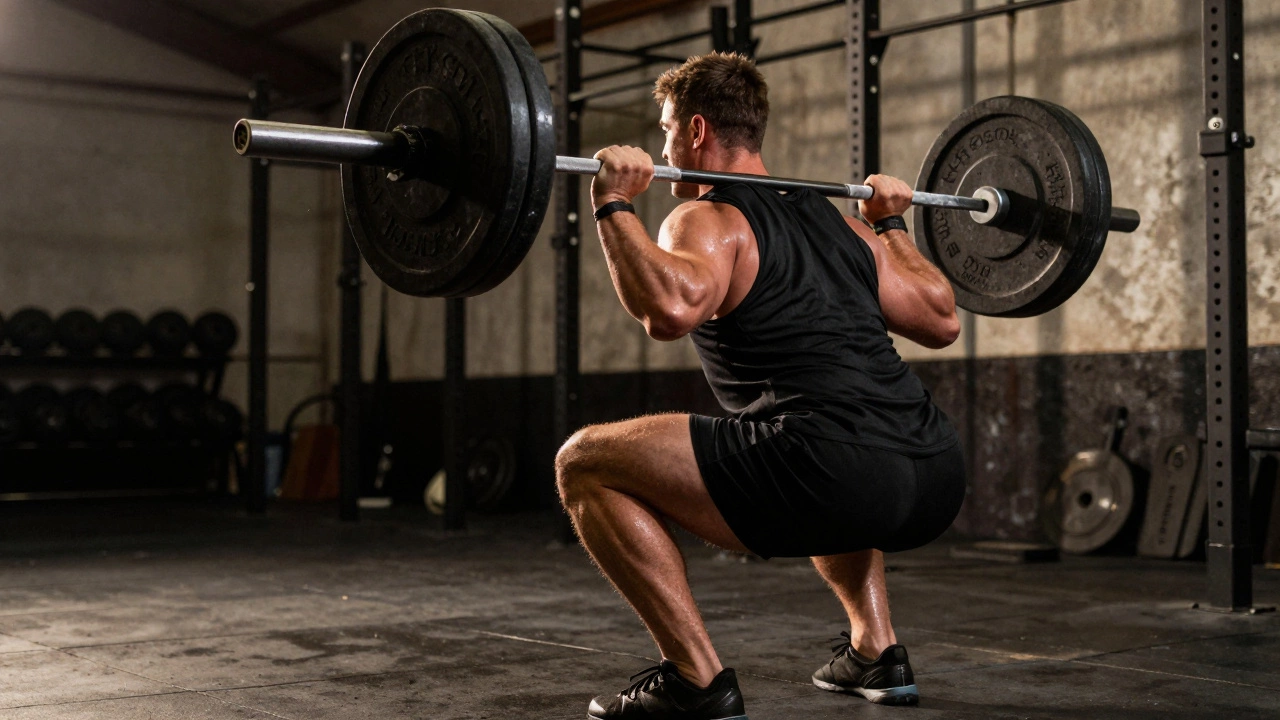
Why Not Everyone Has Them?
You might notice that the hooker or prop has much thicker legs than the fly-half. This comes down to the specific "job" they do on the field. A fly-half needs to be agile and quick over long distances, so too much bulk would actually slow them down. Their legs are lean and springy. On the other hand, the front row is essentially the anchor of the team. Their job is to provide a stable platform and move a massive amount of weight. Their training is skewed heavily toward maximum strength and mass. It's a targeted approach: the muscle is placed exactly where it's needed for the role they play in the game plan.Can anyone get rugby-sized legs?
While genetics play a role in how muscle is distributed, most people can significantly increase their leg size by following a professional strength program. The key is focusing on compound movements like squats and deadlifts, eating a caloric surplus with high protein, and allowing for adequate recovery. However, the extreme size seen in pro players is often a result of years of elite-level coaching and a full-time commitment to recovery.
Do big legs make you slower in rugby?
Not necessarily. There is a difference between "non-functional" mass and "functional" muscle. Pro rugby players train for explosive power. While a prop might not win a 100m sprint against an Olympian, their leg mass is designed for short-burst acceleration and stability. When combined with plyometric training, big legs can actually produce more force, making the player faster off the mark.
Which exercise is most important for rugby legs?
The back squat is widely considered the gold standard because it targets the entire lower body and forces the core to stabilize under load. However, many modern coaches emphasize the Romanian Deadlift (RDL) and Bulgarian Split Squats to ensure the hamstrings and glutes are equally developed, as this prevents injuries and improves balance during contact.
Do rugby players use supplements to get those legs?
Most professional athletes use basic, legal supplements like creatine and whey protein to help with muscle recovery and volume. Creatine, in particular, is well-documented for increasing power output in short-burst activities. The primary driver of their size, however, remains the sheer volume of heavy lifting and a high-calorie diet.
How long does it take to build this kind of lower body strength?
Building the level of mass seen in professional rugby players usually takes years of consistent training. It is a gradual process of progressive overload-slowly increasing the weight and intensity over several seasons. Most pros start building their base in their late teens and reach their physical peak in their mid-to-late twenties.